Thursday, 12 January 2012

On Reviewing, Critiquing, Analysing and So Forth

Mark Finn posted a most intriguing piece on the art of reviewing.  I'm glad I missed the kerfuffle on Good Reads, as it's exactly the sort of thing that would have me spluttering in disbelief and indignation, but Mark uses it as a background to an issue I'd been pondering:

When I was a book seller (for years and years) I was called upon to give my opinion about books on a daily basis. Now, this can be tricky. If I tell someone about a book that I hated, that I think sucked, and I say it's the greatest thing ever, then that's a lie. And if they buy that book based on my lie, and hate the book, then guess what? I've lost all of my credibility.

Over the years, I learned the value of tact. It's perfectly okay to say to someone asking about, say, Henry Miller, that "I'm not the best person to ask for a recommendation. I don't personally care for him. I think he's a little too gimmicky." If they asked for more, I'd tell them what made Miller's writing more of a blog trick than actual prose. But I'd always end with, "But that's just me. Other folks here love Miller and can tell you why he's great." I'm not putting down anyone who likes Miller. I'm just explaining why I don't. See how that works? Let me say this out loud, so there can be no misunderstanding: if you're not capable of doing that every time you hit a movie, or book, or record that you don't like, then you're not going to be an effective critic. You're just going to be another nameless, faceless voice in an already crowded Internet yelling "IT SUCKS" from the other side of the lake.

Take a moment to decide if you're a reviewer, or if you're just a reader. If you want to be a reviewer, then you've got to be brilliant. Or gifted. Or both. But if you just want to be a reader, and just want to be able to say what you think, without all of that other stuff getting in the way, then make the effort to say what you mean and mean what you say. Use your words. You're a reader. You of all people should know the value of written communication.

An issue I'd been wrestling with a bit: am I a reader, or a critic?  I've done a bit of both: I've offered my opinions on things without necessarily critiquing them, and I've also done breakdowns and analyses. But which of the two am I aiming for? In fact, why choose?

Monday, 9 January 2012

Hyborian Musings: Aquiromian Holiday, Part Two

"My antipathy for Rome is one of those things I can't explain myself. Certainly it isn't based on any early reading, because some of that consisted of MacCauley's Lays of Ancient Rome from which flag-waving lines I should have drawn some Roman patriotism, it seems. At an early age I memorized most of those verses, but in reciting, changed them to suit myself and substituted Celtic names for the Roman ones, and changed the settings from Italy to the British Isles! Always, when I've dreamed of Rome, or subconsciously thought of the empire, it has seemed to me like a symbol of slavery -- an iron spider, spreading webs of steel all over the world to choke the rivers with dams, fell the forests, strangle the plains with white roads and drive the free people into cage-like houses and towns."
 - Robert E. Howard, letter to HP Lovecraft, ca. February, 1931
Ancient Romans in Feudal Japan? What is this, The Twilight Zone?

An analysis of Conan's armour in "The Phoenix on the Sword," with its references to plumed casques and moveable visors, should indicate that at least Conan's armour would be more Medieval in tone than Classical. That said, arguments could be made that it isn't enough: the ambiguity of "casque" as a phrase and the presence of Roman helms with masks that functioned similarly to moveable visors offer possibilities. However, when taken in conjunction with other clues in the tale, the support for a Romanesque interpretation starts to lose ground.

Nonetheless, it has to be acknowledged that there are Roman or Romanesque elements in the Conan stories.
 "The Phoenix on the Sword" is unusual in that, of all the Aquilonian stories, it contains the most Classical elements. "The Scarlet Citadel," "The Hour of the Dragon" the borderline "Beyond the Black River" and "Wolves Beyond the Border" have practically none outside names. This post will explore and analyse those elements which could be tied to Ancient Rome.

Tuesday, 3 January 2012

A Century and a Score

James over at Grognardia already took the obvious path for a title (damn, wish I thought of that) but I figure Tolkien's twelvetieth birthday was a good time to post some musings I had over Middle-earth. I posted this on another forum, but I figure I'd share it here too, after having made some revisions.

A common complaint I've heard made about Middle-earth, and fantasy settings in general, is stagnation. They claim that there simply isn't enough progress: not enough scientific investigation, no new technological innovations, not even major social upheavals, like you see in "real" history. I never had a problem with Middle-earth's technological progression, personally.  It's extremely difficult to progress when, every few millenia (or even centuries), your entire world is torn to pieces in nothing less than cataclysmic events, where countless lives are lost and the very geography of a continent is altered.


Sunday, 1 January 2012

The First Scholar Passes

Paul Herman has announced that Glenn Lord has died.
Glenn Lord, the World's #1 Howard Fan and Mentor to so many of us, passed away on December 31, 2011.

That's all the details that are available at this moment (11:30 pm in Northwest Indiana).

When more information comes forth it will certainly be posted everywhere.

Rest in Peace, Glenn, our Great and Gracious Friend. 
Glenn Lord was the most important figure in the legacy of Robert E. Howard.  He provided the source text for almost every surviving manuscript used today.  He amassed the largest collection of Howard documents over his life.  He ensured Howard was published in scores upon scores of volumes and collections.  He battled to promote Howard as more than just the spinner of ripping yarns, that he was a true genius whose work had Real Literary Merit. We Howard fans owe him everything. The Howard Boom of the '70s, Howard Days, the unexpurgiated texts, the wide Conan franchise - Glenn Lord had a hand in everything.

No doubt others will provide more detailed and eloquent tributes, but I feel profoundly saddened that I will never meet him. I shall have to suffice by drinking to his shade.

It's a New Year...


My New Year's Resolution is to contain and stifle the great dragon which has been smothering my creativity: Procrastinatrax pejorative. A lot of the time, I'd be working on something, and just never post it: "it just needs more polishing, more work, more tinkering and tweaking." But no amount of tinkering or tweaking ever fully satisfied me. It's a wonder I post anything at all.

I recently put up a post on the Aquiromians. Originally it was much longer, before I decided to split it into parts. I started working on it in April. April 2010. I had a big post on my thoughts on the upcoming Hobbit film's dwarves. I still have tons of reviews of comics, books and the like that I just wasn't happy posting. Well, no more.

And, of course, there's the Encyclopedia. I've amassed tons and tons of notes over the years, but I keep second-guessing myself, so much of the EH as it is now is written from scratch. The temptation was to just take posts I'd made on the REH Forums, The Cimmerian, Hyborian Age Gazetteers, even Conan: Total War previews, and make them fit. That was the original plan. But every so often, I came across some little detail that I had reconsidered. It might've been a pastiche element that slipped through the cracks (Shamar being a pre-Cataclysmic city was one), or a new take (my view of Corinthia had changed dramatically), or even just some weird thing that didn't work out. So I eventually stopped, and decided to just go back to the stories.

But that's been problematic too. The way my mind works, I take time to remember. I can't just draw it forth like CTRL-F on a file: I have to delve through filing cabinets. So this has slowed things down too. But, again, I'm reconsidering my approach.

Hopefully I'll have at least one post a week up, either Encyclopaedia related, or one of those reviews I haven't finished. In any case, Happy Hogmanay, one and all!

Saturday, 31 December 2011

Hyborian Musings: Aquiromian Holiday, Part One

"When I dream of Rome, I am always pitted against her, hating her with a ferocity that in my younger days persisted in my waking hours, so that I still remember, with some wonder, the savage pleasure with which I read, at the age of nine, the destruction of Rome by the Germanic barbarians. At the same time, reading of the conquest of Britain by those same races filled me with resentment. Somehow, I have never been able to conceive fully of a Latinized civilization in Britain; to me that struggle has always seemed mainly a war of British barbarians against Germanic barbarians, with my sympathies wholly with the Britons."
 - Robert E. Howard, Letter to Lovecraft, ca. January 1931...
A wild Aquiromian appears!

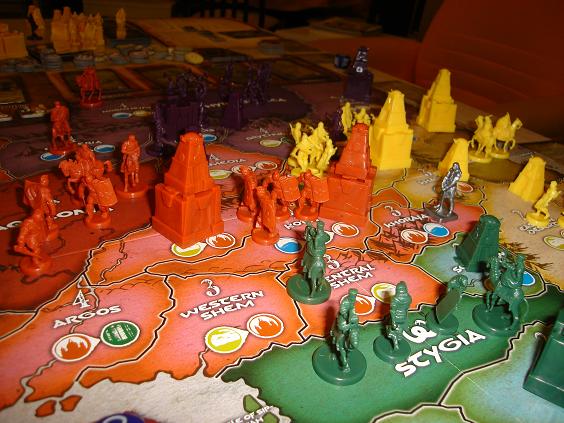
One of my pet Hyborian peeves is the meme which dictates Aquilonia is modelled after the Roman Empire. If you've seen any representation of an Aquilonian in a visual medium, that individual is very likely to resemble a classical Roman. It's endemic in illustration, Marvel and Dark Horse comics, role playing games, video games, board games, even action figures. Aquilonian centurions, Aquilonian legionaries, Aquilonian senators, Aquilonian gladiators... All over the place. When King Conan is illustrated, he's often clad in highly Romanesque attire, be it - again - in books, comics, games, action figures, even films. The implication of Conan wearing Roman attire as king, then, supports the Aquilonia=Roman theme.

The problem is twofold: first, the Aquilonians are not described like Ancient Romans, and second, Robert E. Howard absolutely despised the Romans.

So why is this so prevalent, and why is it such a problem?

Sunday, 25 December 2011

Another classic ruined by Al


'Twas the night before Christmas, when all thro' the house
Not a creature was stirring, not even a mouse;
The stockings were hung by the chimney with care,
In hopes that St. Nicholas soon would be there;
The children were nestled all snug in their beds,
While visions of sugar plums danc'd in their heads,
And Mama in her 'kerchief, and I in my cap,
Had just settled our brains for a long winter's nap —
When out on the lawn there arose such a clatter,
I sprang from the bed to see what was the matter.
Away to the window I flew like a flash,
Tore open the shutters, and threw up the sash.
The moon on the breast of the new fallen snow,
Gave the lustre of mid-day to objects below;
When, what to my wondering eyes should appear,
But a steel battlesleigh, and eight giant reindeer,
Whose great grizzled driver stretched his neck with a crick,
I knew in a moment it must be St. Nick.
More rapid than eagles his coursers they came,
And he whistled, and shouted, and call'd them by name:
"Now! Thrasher, now! Crasher, now! Cancer and Hakon,
"On! Plummet, on! Cesspit, on! Thunder and Blacken;
"To the top of the porch! To the top of the wall!
"Now dash away! Dash away! Dash away all!"
As dry leaves before the wild hurricane fly,
When they meet with an obstacle, mount to the sky;
So up to the house-top the coursers they flew,
With the sleigh full of death — and St. Nicholas too:
And then in a twinkling, I heard on the roof
The thunder and rumbling of each monstrous hoof.
As I drew in my head, and was turning around,
Down the chimney St. Nicholas came with a bound:
He was dress'd all in fur, from his head to his foot,
And his clothes were all tarnish'd with ashes and soot;
A bundle of blades was flung on his back,
Axes and crossbows and swords in his sack:
His eyes burned with balefire, his teeth gleamed like ice,
His thews wrought of iron, his bones hewn from gneiss;
His great savage grin was taut, tight as a bow,
And the beard of his chin was as white as the snow;
The stump of a pipe he held tight in his teeth,
And the smoke it encircled his head like a wreath.
He had a grim face, and a great barrel chest
That shook when he laugh'd at some grim pagan jest:
He was massive and strong, a vision from Hell,
And I scream'd when I saw him in spite of myself;
A wink of his eye and a twist of his head
Soon gave me to know I had reason to dread.
He spoke not a word, but went straight to his work,
And fill'd all the stockings; then turn'd with a jerk,
And clutching me by the crook of the throat,
He leapt up the chimney like a great mountain goat.
He sprung to his sleigh, and shot into the sky,
And dropped me to earth, to scream ere I die:
But I heard him exclaim, ere he drove out of sight —
Happy Christmas to all, and to all a good night.

(With profuse apologies to Clement Clark Moore.  I was compelled to put something up for Christmas, so here's another classic ruined by shameless editing. As ever, I wish all my readers and Howard fans a marvellous Mitramas, a super Set Sacrificial Festival, a solemn, cheerless Cromhain, and of course, a merry Christmas!)

Wednesday, 21 December 2011

I truly wish I could enjoy this...


See, I loved The Lord of the Rings: The Fellowship of the Ring when it came out. I was just so blown away to see an adaptation that actually stuck to the books to a degree most supposed adaptations dismiss as "unnecessary," "unfilmable" or otherwise "undesireable," that I ranted and raved about it for ages. Then The Two Towers came out, and I started to pick at the threads.  I started to become bothered by the changes. By the time of The Return of the King, most of my enthusiasm for the franchise was replaced with a nagging preoccupation with a little voice saying "no, this isn't the best possible adaptation of The Lord of the Rings we could hope for." Best we could get given Hollywood's boundless stupidity and soulless money-oriented goals?  Perhaps.  Best we could hope for, though?

So the trailer for The Hobbit: An Unexpected Two Parter hit the 'net, and the Tolkien fandom rejoiced.  And why not?  Everything I saw in the Lord of the Rings film trilogy was plain in evidence, in all the good and bad it entails.  Lots of gorgeous scenery, astounding attention to detail in the costuming, props and sets, sweeping catchy orchestral score, the occasional direct quote from Tolkien that gets me grinning madly, tempered by maudlin melodrama like Galadriel brushing away Gandalf's hair, lots of cod-Bergman staring-into-the-middle-distance, and needless tie-ins to the previous films.

I just feel like such a Grinch, you know? So many people are looking forward to this, and I'm almost positive that those people are not going to be disappointed. Everything from the Jackson trilogy is probably going to be in this, and while everyone dismisses the stupid alterations and redundant additions as "necessary to the process of adaptation" while they enjoy themselves, I'm just going to be stuck in a huff.  There are few upcoming films I wish I could be excited about.  I wish I could watch a trailer for The freaking Hobbit and feel the same convulsions of joy I did on seeing, say, the trailer for Jurassic Park. But I can't.

To be frank, I'm feeling something of a malaise.  I haven't seen a single trailer that engenders any degree of enthusiasm or excitement in me for any upcoming film, be it anticipated blockbusters like The Avengers or The Dark Knight Rises, appeals to my Scottish sensibilities like Brave, or pleasant surprises like The Wicker Tree. Even the initial "that doesn't actually look that bad" optimism from John Carter and Wrath of the Titans (I'm surprised as you are) is dampened by cynicism.  Have I truly become a cynical old grump at last? Did Conan the Barbarian break something in my brain, shorting the Optimism fuse for ever?  Or will the anticipated Prometheus trailer restore some sense of excitement?

Oh well.

Thursday, 15 December 2011

Hyborian Musings: Mappa Mundi

A quickly-rendered composite utilizing the two maps included in Del Rey's Conan collections

The subject of maps for the Encyclopaedia.  On the one hand, I'd really like to have a big grand map of the Hyborian Age just to show the breadth and depth of Howard's creation, based upon the best suggestions, ideas and hypotheses.  On the other, it seems contradictory to try to separate pastiche from Howard, only to introduce my own theories in the process, muddying the waters.

From a strict "REH-only, nowt but" perspective, the only satisfying answer would be to just use Howard's own maps.  The problem is... well, they aren't very detailed, or photogenic.  They weren't intended to be either.  Howard's maps were his own sketches, drawn in his own time, so he could get a feel for the Hyborian Kingdoms' geopolitical structure while writing the stories.  In this, they obviously succeeded - but they weren't intended for publication by Howard himself, since they're just a series of lines overlaid on a map of Europe.  Many landmarks, cities, rivers, mountains, and other features are missing, and a good portion of the landmass is left off in the south and east.

Part of me wants to honour Howard's desire to keep the Black Kingdoms and the Blue East vague, mysterious and unknown to the reader.  However, another part feels that any future pasticheurs may feel that the lack of a map, even a speculative one, of any given area gives them carte blanche to do whatever they like. So in leaving out any depictions of Vendhya, Hyrkania, Zembabwei, Khemu and beyond, a future comic or book author might get the impression "well, that means I can just stick in a super-advanced kingdom the size of Aquilonia ruled by dragonfly-riding people in the middle of the Black Kingdoms - after all, there's nothing to say there couldn't be such a place, right?"

Thus the dilemma.

I think the best solution is to do both: provide a map based only on Howard's documents, and an expanded map based on current theories - and make sure it's delineated as such.  The map based on REH's map is described as being based on REH's map, and thus set in stone, as it were.  The map based on various theories, such as the outstanding work by Dale Rippke in the Blue East and Black Kingdoms, however, has a bit of leeway, within reason, and is defined as theoretical.  I might have fun with the literary agent hypothesis here.

Thursday, 8 December 2011

Hyborian Musings: The Conan Calendar

I've been wrestling with dates in regards to the Encyclopedia. "Three thousand years before the time of Conan," "nine hundred years before Conan's time," and whatnot.  While correct enough, it also seemed a bit clumsy and redundant.  But what could replace it?  Initially I was wanting to knock out a hard timeline, where every major event of the Hyborian Age was listed and put in context, like this one for the Cthulhu Mythos, or this for Tolkien's mythos.  My initial thought for the reckoning was using the Cataclysm: after all, what more profound and earth-shattering event could one choose for the timeline than the one which rocked the foundations of the earth?  Unfortunately, "The Hyborian Age" has proven immensely difficult to work with due to later stories' contradictions.  Published stories take precedents over private notes, true, but so much Hyborian history is found in the essay, one wonders what to do with it.

Then it hit me: I was using the wrong reckoning.  Instead of using the cataclysm, why not use the one element which is most constantly used as a marker between events of the Hyborian past and present?

My proposal is to organise everything around Conan.  Of course, I thought, it's so simple!  We could even include the traditional B.C. to serve as the "ancient time," and the succeeding period starting with A:

B.C. = Before Conan
A.C. = After Conan

The next question is shrinking it down: what time in Conan's life should serve as the reckoning?  The traditional Gregorian calendar immediately made me think of using Conan's birth, but many cultures use the start of a ruler's reign.  Conan is clearly one of the most important historical figures of the Hyborian Age, if not quite the religious figure Jesus turned out to be, but in any case, it's the perfect marriage of accessibility and simplicity.  So perhaps...

B.C. =  Before (the reign of) Conan
A.C. = Age of Conan

Using this system, we can then say (for example):

  • 10,000 BC Birth of Akivasha
  • 3,000 BC   Fall of Acheron
                      Fall of Kuthchemes
                      Foundation of Khorshemish
  • 1,500 BC   Death of Epemitreus the Sage
  • 1,000 BC   Bossonian Marches first established
  • 900 BC      Death of Epeus of Aquilonia
                      Gazali migrate from Koth
  • 500 BC      First of five-hundred-year period of intermittent war between Aquilonia and Nemedia
  • 300 BC      Yara captures and enslaves Yogah
  • 100 BC      Bloody Tranicos disappears
  • 40 BC        Birth of Conan
  • 26 BC        Battle of Venarium
  • 23 BC        Disappearance of Yara and destruction of the Elephant's Tower
  • 10 BC        War of the Barons in Aquilonia
  • 0 AC          Age of Conan begins
  • 5 AC          Aquilonian-Nemedian War
  • 500 AC      Pictish Empire destroys Aquilonia

By Crom, I think this could work.